
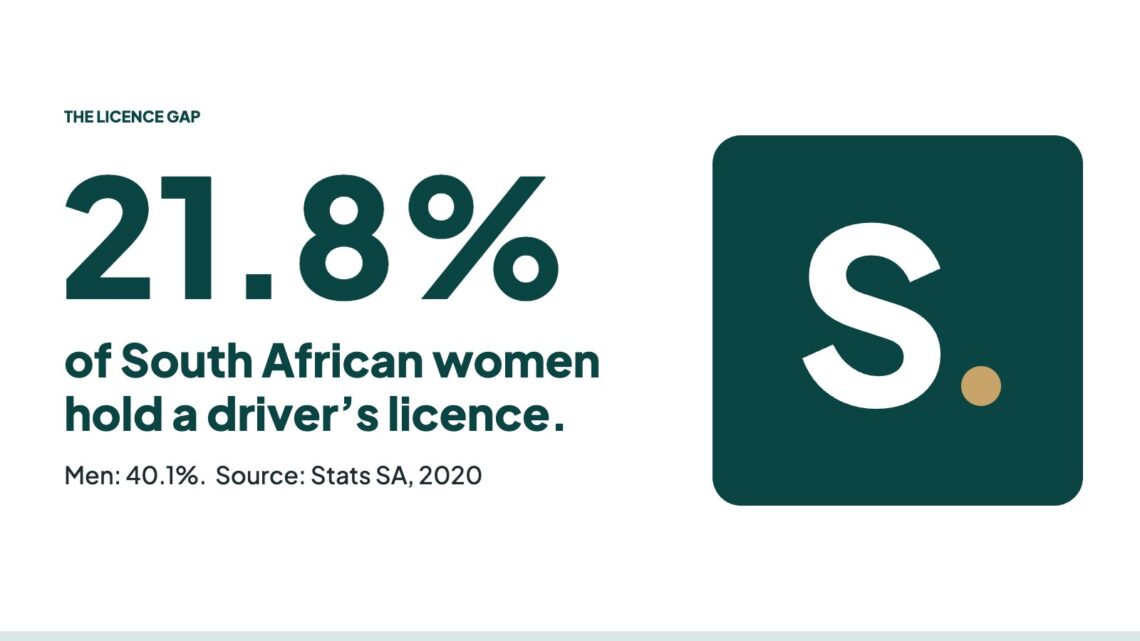
Fewer than one in four South African women holds a driver's licence. For men, it is two in five. That gap shapes how women get to work, how safely they travel, and which jobs are open to them.
The numbers
Statistics South Africa's most recent gender and transport report found that in 2020, 21.8% of women held a driver's licence, compared with 40.1% of men. Black African women had the lowest rate of any group, at 13.4%, up from 9.6% in 2013.
The national licence register tells the same story. By December 2025, South Africa had 16.5 million driving licences on the NaTIS system, and the Road Traffic Management Corporation reports that holders are split 61.1% male and 38.9% female. That is roughly 10 million men and 6.4 million women.
What the gap means day to day
Without a licence or a car, women depend on others to move. In 2020, taxis were the most common way for working women to commute (33.6%), while men were far more likely to drive themselves to work: 41% of male commuters were car drivers, 11.8 percentage points more than women. Among students in post-school education, more than 47% of women travelled by taxi, compared with 34.7% of men.
Stats SA links limited transport to reduced access to learning, jobs and everyday life, and notes that women face added risk walking to stops, waiting at ranks and travelling, particularly late at night.
A jobs issue, not only a transport issue
The licence gap sits alongside a jobs gap. In the second quarter of 2026, the official unemployment rate was 37.5% for women and 30.3% for men, and only 54.9% of women were in the labour force, compared with 64.4% of men.
A licence opens doors that stay closed without one, including professional driving itself, a field where women remain under-represented.
What SheCab is doing
SheCab was founded in 2021 to give women transport they can trust, driven by women. Today, 32 professional women drivers are on the road with us.
We want to grow that number. SheCab plans a programme, with partners, that takes women from learner's licence to paid, professional driver:
- Licence support: funding for learner's and driver's licences, and lessons, for women from under-served communities.
- Professional driver training: defensive driving, customer care, first aid and passenger safety.
- A paid pathway: graduates can earn as vetted SheCab drivers in airport, corporate and scholar transport.
Partner with us. We are looking for corporate social investment partners, SETAs, driving schools and vehicle partners to fund and grow this programme. Contact us at info@shecab.co.za.
Sources
- Statistics South Africa, Women are unequal on the road and in life (Gender Series Volume VIII: Gender patterns in transport, 2013 to 2020).
- Road Traffic Management Corporation, State of Road Safety in South Africa, 2025.
- Statistics South Africa, Gender gaps persist in South Africa's labour market (Quarterly Labour Force Survey, Q2 2026).



 August 9, 2025
On this Women’s Day, we pause to recognize and thank the many women who form the heart of our community, the women who drive, support, and use our service every day with courage and care.
Across South Africa, women face many challenges, including the daily realities of insecurity and violence. Yet, the women who drive for us, whether full-time or part-time, show incredible resilience and professionalism. They balance the demands of work and family, often driving to support their loved ones or providing extra income. Others drive simply because they find joy and independence behind the wheel.
These women are more than drivers, they are caregivers, friends, and protectors on the road. Their kindness, patience, and calm presence help create a safer environment for all passengers, especially women who rely on safe transport to reach work, school, or home.
Behind the scenes, many women work quietly and diligently in administrative roles, supporting the daily running of the service and ensuring that everything operates smoothly. Their dedication is a vital part of this community.
And to the thousands of women who choose to travel with us, your trust inspires us every day. Together, all of these women contribute to a shared goal: creating safer spaces and building a supportive network where women can move without fear.
Today, we honor all of you, the women who drive, support, and travel, recognizing your strength, your care, and your important role in making every journey safer.
Thank you for your resilience, your kindness, and your commitment.